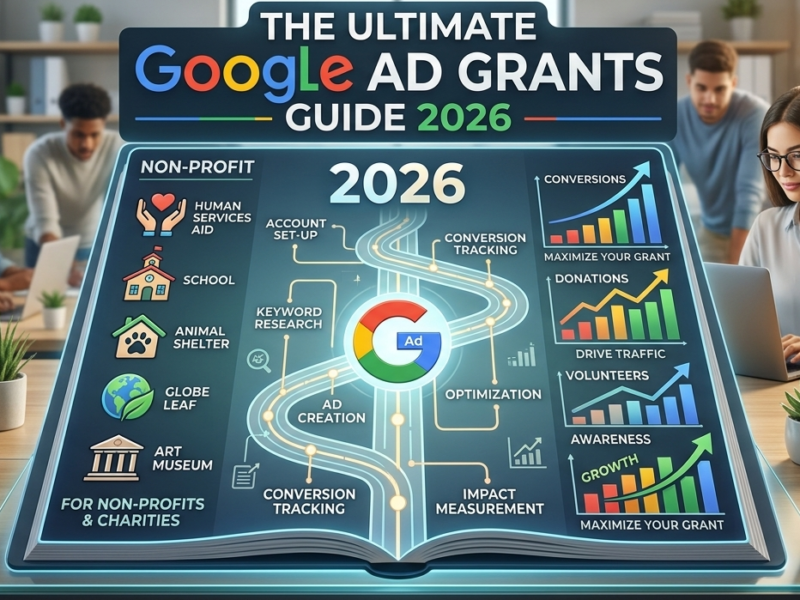
The Ultimate Guide To Google Ad Grants 2026
Navigate Google Ad Grants with confidence.
Google Ad Grants is one of the most powerful yet underutilized tools available to nonprofit organizations. Through the program, eligible nonprofits receive up to $10,000 USD per month in free Google Ads advertising credits, allowing them to reach people actively searching for causes, services, volunteer opportunities, educational resources, and ways to make a difference.
While the idea of receiving $120,000 per year in free advertising sounds simple, many organizations quickly discover that running successful Google Ad Grants campaigns is very different from running campaigns in a commercial Google Ads account. Strict compliance requirements, limited ad formats, evolving automation, and Google’s growing reliance on artificial intelligence all create unique challenges that nonprofits must overcome.
This guide covers everything from eligibility and account setup to advanced optimization strategies, compliance management, application process, and more!
What Is Google Ad Grants?
Google Ad Grants is a product of the Google for Nonprofits program, Google’s philanthropic initiative designed to help nonprofit organizations connect their mission with individuals searching for support, information, or ways to get involved. Eligible organizations receive up to $10,000 per month in advertising credits that can be used exclusively for Google Search campaigns.
Unlike a traditional grant, Google Ad Grants does not provide cash funding. The program offers advertising credits that can only be used within Google Ads. These credits allow nonprofits to appear in Google Search results when users search for relevant keywords.
For example, an animal rescue organization may appear when someone searches for “adopt a dog near me.” A food bank could appear when users search for “food assistance program,” and a healthcare nonprofit might show ads for searches related to support services, screenings, or educational resources.
Organizations commonly use Google Ad Grants to:
- Connect individuals with programs and services
- Increase participation in events, workshops, and community initiatives
- Attract new volunteers and advocates
- Encourage online donations and recurring giving
- Raise awareness of important social issues and campaigns
- Promote educational content, resources, and research
- Drive registrations for trainings, webinars, and support groups
- Expand email lists and supporter communities
- Increase engagement with petitions, advocacy efforts, and public policy initiatives
At its core, Google Ad Grants enables nonprofits to participate in conversations that are already taking place. By positioning relevant content alongside high-intent searches, organizations can engage prospective beneficiaries, supporters, and advocates at critical decision points. The result is a more deliberate and efficient approach to outreach, one that supports organizational priorities while fostering deeper connections with the communities they serve.
Who Is Eligible For Google Ad Grants?
Eligibility begins with qualifying for Google for Nonprofits. In the United States, organizations generally must hold valid 501(c)(3) status recognized by the IRS. Similar nonprofit designations apply in other countries. However, not every mission-driven organization qualifies.
Organizations that are ineligible include:
- Governmental institution
- Hospitals and healthcare systems (certain community health care providers may still be eligible)
- Schools, colleges, and universities (philanthropic arms of educational institutions may still be eligible)


To qualify, nonprofits must also maintain a high-quality website that clearly explains their mission, programs, services, and impact.
Google expects websites to include:
- HTTPS security (SSL certificate)
- Clear organizational information
- Accurate contact details
- Original and extensive content
- Easy navigation
- Transparent donation practices
- Mission-focused information
A weak or incomplete website is one of the most common reasons applications are delayed or rejected.
How To Apply For Google Ad Grants
The application process involves several steps that must be completed in the correct order.
1. Organizations must apply for Google for Nonprofits.
2. During this process, Google requires verification through Goodstack, formerly known as Percent. Goodstack serves as Google’s nonprofit verification partner and reviews legal registration documents, charitable status, and organizational legitimacy.

Common causes of verification delays include:
- Wrong legal status (e.g., 501c6 instead of 501c3)
- Ineligible organization type (e.g., Hospitals, Governmental intitutions)
- The organization being too new
- User errors (Typos, wrong organization selected, missing documents, etc.)
- Submitting the same rejected documents repeatedly
We explore this topic in more detail in the webinar below.
3. Once verification is approved, organizations can activate Google Ad Grants through the Google for Nonprofits dashboard.
Find detailed instructions for the application process here.
One of the most important rules during activation is that nonprofits should not create their own Google Ads account. Google provides a dedicated Ad Grants account and invites administrators after approval. Creating a standard Google Ads account beforehand can create complications and, in some cases, trigger billing issues.
While Google Ad Grants is often the most recognized benefit, eligible organizations can access additional resources through Google for Nonprofits such as Google Workspace for Nonprofits, which provides collaboration and productivity tools, and the YouTube Nonprofit Program, which offers features designed to help organizations engage supporters through video content.
How Google Ad Grants Works & How Is It Different From A Commercial (Paid) Google Ads Account?
Every day, millions of people turn to Google to find answers, services, and organizations that can help them. One of the biggest advantages of Google Ad Grants is the ability to connect with people who are already looking for information related to your mission. Rather than interrupting users with promotional messages, search advertising allows nonprofits to engage individuals who have expressed a clear interest through their search queries.
Although Google Ad Grants uses the same Google Ads platform as commercial advertisers, the program operates under very different rules.
Paid advertisers have access to:
- Search campaigns
- Display campaigns
- YouTube campaigns
- Demand Gen campaigns
- Shopping campaigns
- Remarketing campaigns
Ad Grants participants are limited primarily to Google Search. In addition, commercial advertisers always receive priority placement in ad auctions. Grant advertisers compete only for available ad positions after paying advertisers have been considered. This means nonprofits cannot rely solely on maximized bids and budgets to win a spot. Instead, success depends heavily on relevance, comprehensive account structure, well-thought-out strategy, etc.
The “Midnight Disappearing” Budget
- Daily Allowance – The 329 daily portions.
- “Use It or Lose It” – This budget is strictly non-cumulative. If you only use $50 of your credit by 11:59 PM, the remaining $279 vanishes into thin air at midnight. It does not roll over to the next day.
- The Pay-Per-Click Deduction – The “funds” are only deducted when someone actually clicks on your ad. Seeing your ad (an impression) is free, but every click “redeems” a portion of your daily voucher.
- Store Credit, Not Cash – Because this is “in-kind” credit, you are never actually charged real money for this spend. However, this also means the credit cannot be used for anything else, such as paying for agency management fees or video production.
Understanding Compliance Requirements
In addition to campaign format limitations, Google Ad Grants accounts must also comply with a set of program-specific requirements that do not apply to commercial Google Ads accounts. Google regularly reviews grant accounts to ensure they are being actively managed and used effectively to support nonprofit missions.
Some of the key compliance requirements include:
- Maintaining a minimum 5% account-wide click-through rate (CTR) each month.
- Configuring conversion tracking and tracking at least 1 conversion per month.
- Avoiding overly generic keywords and single-word keywords.
- Maintaining at least two active ad groups per campaign, each with relevant keywords and 1 responsive search ad.
- Regularly monitoring and optimizing campaigns.
Failure to meet these requirements can result in suspension, or even account deactivation. While commercial advertisers have complete flexibility in how they structure and manage their accounts, Google Ad Grants participants must balance performance optimization with ongoing compliance. For this reason, successful grant management requires continuous oversight, regular account maintenance, and a strategic approach.
You can find a comprehensive comparison of grant and commercial Google Ads campaigns here.
Smart Bidding As Your Go-To Strategy
Historically, Google Ad Grants accounts were restricted by a $2 manual bidding cap. This made it difficult to compete for high-intent search terms. Today, Smart Bidding has fundamentally changed the program.
Successful accounts now rely on automated bidding strategies such as:
- Maximize Conversions
- Maximize Conversion Value
- Target CPA
Smart Bidding allows Google’s machine learning systems to adjust bids in real time based on the likelihood of conversion. On top of that, the use of Smart Bidding strategies has become mandatory for all Ad Grantees.
Why Conversion Tracking Is Non-Negotiable
Conversion tracking is not optional. According to compliance requirements, Google requires nonprofits to track at least 1 conversion per month.
Examples of conversions we typically track in our clients accounts:
- Donation button clicks
- Volunteer button clicks
- Contact form submissions
- Event registrations
- Newsletter subscriptions
- White paper downloads
- Service inquiries
- Appointment requests
- and basic engagegement conversions inclusing session duration and page views
Nonprofits often make the mistake of tracking only donations. While donations are important, they often occur too infrequently to provide sufficient data for Smart Bidding. Successful organizations typically track multiple conversion actions to give Google’s algorithms more optimization signals.
The Strategic Role Of Content in Google Ad Grants
A common misconception is that Google Ad Grants success is driven primarily by campaign settings, keyword selection, or bidding strategies. While these elements are important, they are only part of the equation. The effectiveness of a Google Ad Grants account is ultimately influenced by the quality, depth, and relevance of the content that supports it.
Google’s advertising system is designed to connect users with the most relevant information available. As a result, organizations that invest in developing keyword-optimized content are often better positioned to achieve stronger performance than those relying on generic website pages. A well-developed content system helps search engines understand the organization’s areas of expertise, strengthens the connection between keywords and landing pages, and provides users with information that directly addresses their needs and interests.
The nonprofits that spend the highest percentage of their grant typically invest heavily in:
- Program pages
- Service pages
- Blog content
- Resource libraries
- FAQs
- Success stories
- Educational guides
Content development also supports one of the most important principles of Google Ad Grants: relevance. The closer the relationship between a user’s search, the ad they click, and the information they find on the landing page, the more likely a campaign is to generate meaningful engagement. For this reason, content should not be viewed as a supplementary marketing activity, but as a foundational element of a sustainable and high-performing Google Ad Grants strategy.
Keyword-optimized content usually means:
- More keywords
- Better Quality Scores
- More impressions
- More conversions
- Higher grant utilization
To learn more about this topic, watch our webinar below.
AI Is Reshaping Google Ad Grants
Artificial intelligence now influences nearly every aspect of Google Search and Google Ads.
Google increasingly relies on AI for:
Make Your Responsive Search Ads Stand Out
Responsive Search Ads have become the standard format for Ad Grants campaigns. Instead of creating a single static ad, advertisers provide multiple headlines and descriptions that Google combines dynamically, see below.
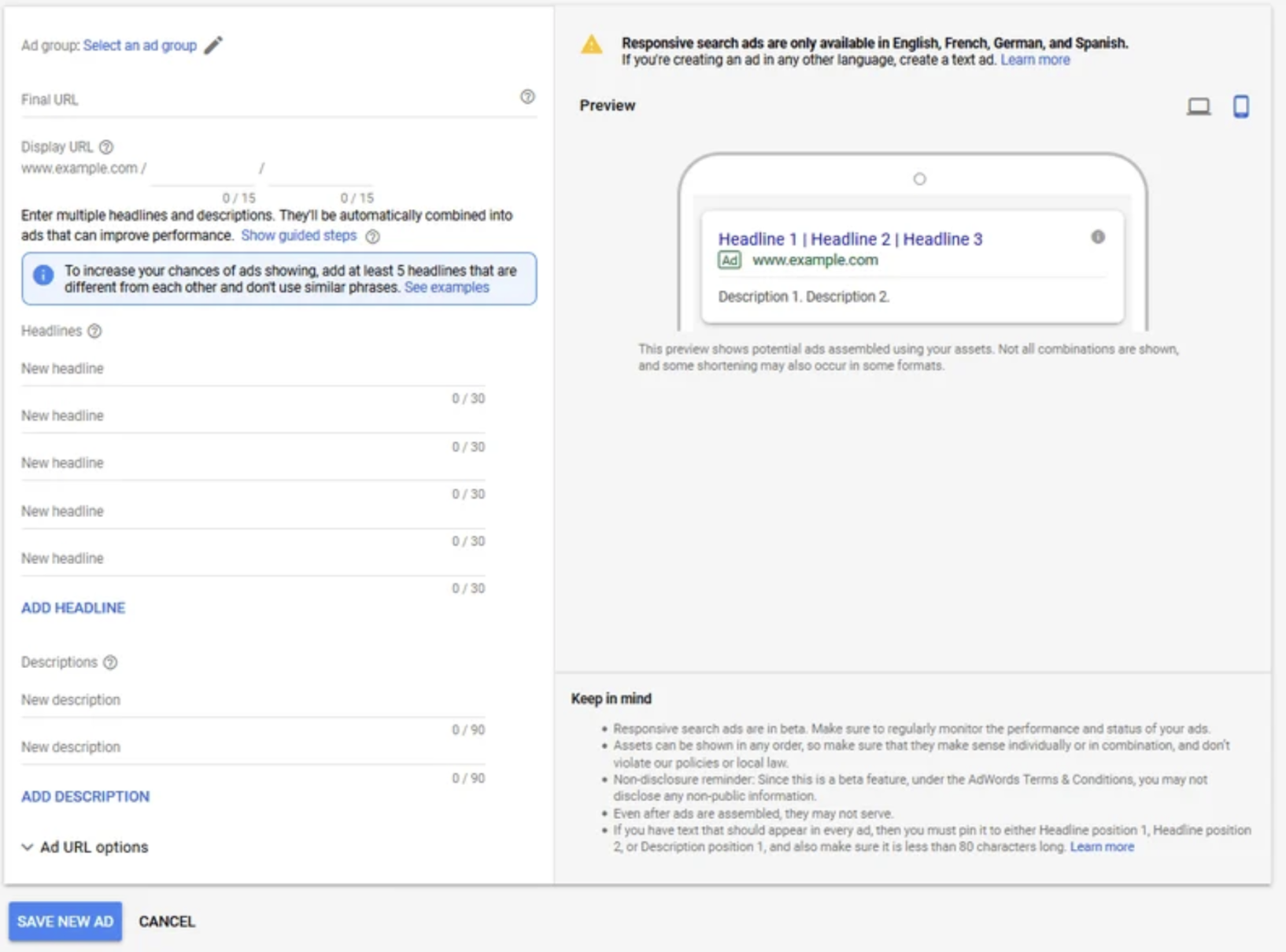
To create a well-built RSA, you should:
- Implement Google’s suggestions
- Use as many texts as possible
- Test various call-to-actions and landing pages
- Use all relevant ad extensions
- Use popular keywords in ad texts
- Follow all editorial guidelines to avoid ad disapproval
- Make sure each text makes sense on its own. Keep in mind that the order of the text elements can change. Texts can be pinned to a certain position.
- Use at least 1 RSA in every ad group. Google no longer requires 2 ads per ad group (one of the compliance requirements). 1 RSA per ad group is enough to achieve compliance.
The goal is to give Google’s AI enough assets to identify the best-performing combinations for each search.
Advanced Strategies Used By Top-Performing Nonprofits
Organizations that consistently achieve high grant utilization typically take an iterative approach. Rather than treating Google Ad Grants as a set-and-forget program, they view it as a long-term digital marketing channel that requires continuous refinement.
- Ensure their website is fast, clear, and compliant.
- Max out their daily budget, unused funds are lost.
- Use smart bidding (Maximize Conversions, Target CPA).
- Leverage Performance Max and Dynamic Search Ads.
- Focus on high-search-volume, low-competition keywords.
- Write clear, compelling ads and utilize ad extensions.
- Expand campaigns monthly based on top-performing terms.
- Start broad with geo-targeting.
- Track conversion actions.
- Continuously develop new website content that is keyword-optimized.
- Monitor and optimize weekly for best results.
A Realistic Perspective On Google Ad Grants
Google Ad Grants can be an exceptionally valuable asset for nonprofits, but its greatest strength often becomes apparent when viewed through the right lens. Organizations that approach the program expecting the same level of immediacy, flexibility, and competitiveness as commercial Google Ads accounts are often disappointed. Greater success tends to come from understanding how the grant complements, rather than replaces, an organization’s wider marketing and engagement efforts.
At its core, Google Ad Grants is designed to help nonprofits increase traffic volume, attract the right audiences, and create meaningful engagement over time. Success rarely comes from launching a handful of campaigns and waiting for results. Instead, it is built through continuous optimization, strategic content development, comprehensive conversion tracking, and a willingness to let data guide decision-making.
Perhaps most importantly, Google Ad Grants should be viewed as one component of a larger marketing framework rather than a standalone solution. While it can generate awareness, website traffic, and valuable engagement signals at scale, organizations often achieve the strongest outcomes when they combine the grant with other channels such as commercial Google Ads, email marketing, social media, etc.
When expectations are aligned with reality, Google Ad Grants transforms from a source of frustration into a sustainable mechanism for long-term organizational growth.
Conclusion
Google Ad Grants remains one of the most valuable resources available to nonprofit organizations. Yet the program has evolved significantly from its early days. Success now depends less on simply creating the perfect ad and more on building a complete strategy that includes high-quality content, conversion tracking, Smart bidding strategies, strong landing pages, and ongoing optimization. The nonprofits that achieve the greatest results are those that embrace Google’s automation while maintaining strict compliance and a relentless focus on relevance.
The formula for Ad Grants success in 2026:
- Strong content generates relevance.
- Relevance improves Quality Score.
- Higher Quality Scores increase your reach.
- Wider reach creates website traffic and conversions.
- More conversions power Google’s AI systems.
- And better AI optimization ultimately allows organizations to maximize the full value of their $10,000 monthly grant.
If you have any questions regarding your Google Ad Grants account, or if you need help with scaling it up, don’t hesitate to reach out!
Back to previous pageAsk our free AI chatbot.
Blog
Useful Nonprofit Marketing Tips & Tricks




- Ad Grants
- News
A Nonprofit’s Guide To Measuring AI Visibility
Know where your organisation appears.
Read more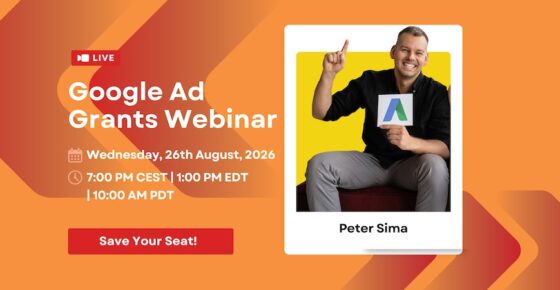



Contact us directly or schedule a slot to talk to our expert team!
- AboveX Digital LLC
- 4023 Kennett Pike #50116, Wilmington, DE 19807 USA
- +1 (619) 330-9997
- Mon – Fri 9:00 am – 5:00 pm EST
- info@abovexdigital.com