The End Of Dynamic Search Ads
AI Max is becoming the new standard.
For years, Dynamic Search Ads (DSA) have been the dependable safety net of Google Ads campaigns. They quietly worked behind the scenes, capturing additional searches that advertisers had never considered targeting and helping nonprofits find new supporters without building endless keyword lists (you can learn more about DSA in our webinar below).
But the search landscape has changed. According to Google, people no longer search in simple, nor predictable ways. They ask longer questions, combine multiple intents, and increasingly rely on AI to discover products, services, and solutions to their problems. To keep pace with this evolution, Google is preparing advertisers for what it calls the “new era of Search.” And that era has a name, AI Max.
AI Max Exiting Beta
Google recently announced that AI Max for Search campaigns is officially moving out of beta, marking one of the most significant updates to Search advertising in recent years. More importantly, Google plans to automatically upgrade several legacy campaign features, including Dynamic Search Ads (DSA), Automatically Created Assets (ACA), and campaign-level broad match settings, to AI Max. This isn’t simply a feature update. Google is trying to signal that Search advertising is moving beyond manual keyword management and toward AI-led optimization.
Why Google Is Retiring Dynamic Search Ads
When Dynamic Search Ads launched, they solved a common problem. Advertisers couldn’t possibly think of every keyword their customers might use. DSA used website content to automatically generate headlines and send users to relevant landing pages. It was an efficient way to capture additional traffic without manually expanding keyword lists.
However, today’s search behavior has become far more complex. Consumers tend to search conversationally. They ask detailed questions. They combine multiple needs into a single query. In many cases, the exact search terms have never been seen before. Google believes relying primarily on landing-page content is no longer enough. AI Max expands beyond website content and incorporates richer, real-time intent signals to understand what users are actually looking for in the moment. In short:
DSA reacted to website content. AI Max reacts to user intent.
What Makes AI Max Different?
At first glance, AI Max may feel familiar to advertisers who have used DSA. It still helps capture searches that weren’t previously on your radar and automatically match your ads to relevant user queries. The difference lies in how much smarter the system has become.
Instead of scraping content from your website, AI Max learns from your existing ads and website content, only then tailors the assets to specific user queries. This allows campaigns to show up for relevant searches that traditional keyword targeting or DSA may never have discovered. Google reports that advertisers using the full AI Max feature suite see an average of 7% more conversions or conversion value at similar CPA or ROAS levels compared to using search term matching alone.
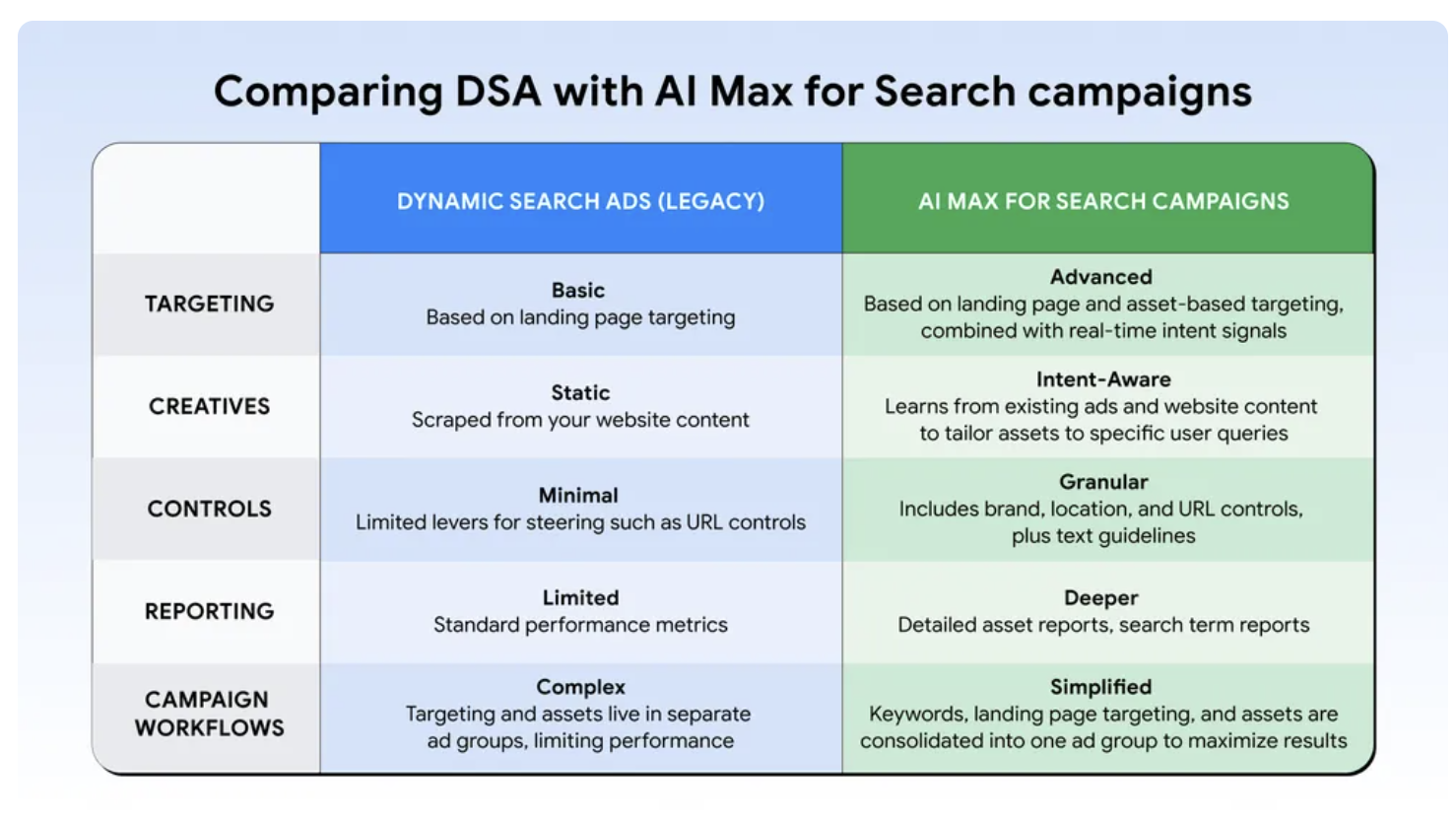
(Google, 6/29/2026, Comparing DSA with AI Max for Search campaigns, https://blog.google/products/ads-commerce/dsa-upgrade-to-ai-max-2026/)
Can More Automation Still Leave You In Control?
One of the biggest concerns advertisers have whenever Google introduces more automation is the fear of losing control. AI Max is supposedly addressing this matter. While this feature relies heavily on AI, Google has added several advanced controls that many advertisers have requested:
- Brand Lists (Inclusions & Exclusions) – Advertisers specify exact brands their ads can be associated with or prevent ads from appearing alongside specific brands.
- Location of interest – More precise geographic guidance allows businesses and nonprofits to steer AI toward their highest-priority markets, target users who show geographic intent for a specific area, regardless of their actual physical location. This gives you granular control over the types of geo-searches your ads trigger for.
- URL Controls – Advertisers can prevent the AI from pulling or linking to specific landing pages on their site.
- Text Guidelines – Rather than leaving creative decisions entirely to automation, advertisers can provide instructions that influence generated ad content. Define messaging guardrails in your own words (e.g., “don’t use overly promotional words” or “don’t use language like ‘the best’)
Google’s official resources suggest that AI Max isn’t designed to replace advertiser decisions. Instead, it is supposed to build on them, using your inputs to guide the campaigns towards your objectives.
What Happens Next?
Google originally planned a faster sunset for Dynamic Search Ads, but after receiving feedback from advertisers, it extended the transition timeline. Here’s the updated roadmap:
Phase 1: Voluntary Upgrades
Google is encouraging advertisers to move voluntarily before automatic upgrades begin. For DSA campaigns, upgrade tools are already being rolled out to help transfer historical settings and performance data into new standard ad groups.
Phase 2: Automatic Upgrades Begin
Starting in September 2026, Google will begin automatically upgrading eligible campaigns using:
- Dynamic Search Ads
- Automatically Created Assets
- Campaign-level broad match settings
After this point, advertisers will no longer be able to create new DSA campaigns through Google Ads, Google Ads Editor, or the Google Ads API. The complete sunset and automatic transition of DSA campaigns will begin in February 2027.
The Bigger Picture
For years, success in Search depended on building the perfect keyword list. Today, success increasingly depends on helping AI understand what you do, your audience, and your goals. Keywords are not disappearing, but they are becoming one signal among many. AI Max represents Google’s vision of what Search advertising looks like in a world where AI can interpret intent, predict relevance, and reveal opportunities people would never manually discover. The question for advertisers is no longer whether AI will become part of Search advertising. The question is how quickly they can learn to work alongside it.
Conclusion
Dynamic Search Ads have been a trusted tool for over a decade, but Google’s latest announcement indicates that the future of Search advertising is inevitably moving toward greater automation. AI Max is not simply the successor to DSA. It is Google’s attempt to redefine how Search campaigns discover, match, and convert users in an increasingly complex search environment. For advertisers, agencies, and nonprofits alike, now is the ideal time to start experimenting, testing, and learning. Because when the automatic upgrades arrive, AI Max won’t be the future anymore, it will be the new standard.
Need help turning on all the features in AI Max? Reach out to our team!
Back to previous pageAsk our free AI chatbot.
Blog
Useful Nonprofit Marketing Tips & Tricks


- Ad Grants
- News
A Nonprofit’s Guide To Measuring AI Visibility
Know where your organisation appears.
Read more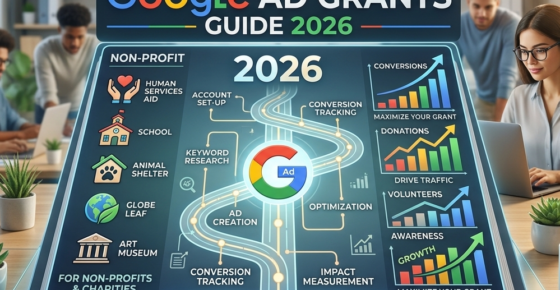
- Ad Grants
- News
The Ultimate Guide To Google Ad Grants 2026
Navigate Google Ad Grants with confidence.
Read more


Contact us directly or schedule a slot to talk to our expert team!
- AboveX Digital LLC
- 4023 Kennett Pike #50116, Wilmington, DE 19807 USA
- +1 (619) 330-9997
- Mon – Fri 9:00 am – 5:00 pm EST
- info@abovexdigital.com